

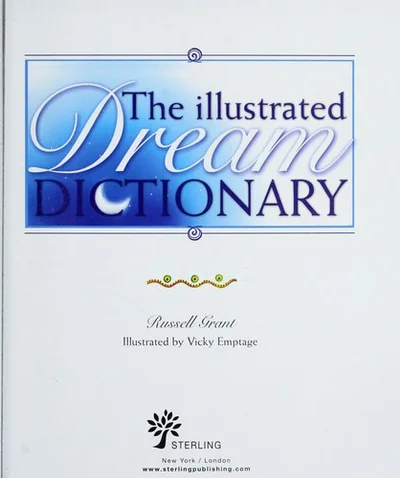
The Illustrated Dream Dictionary
by Russell Grant
An honest review of Russell Grant’s The Illustrated Dream Dictionary, covering what it is, what it misses, who it helps, and how it sits in dream literature.
Russell Grant’s The Illustrated Dream Dictionary sits in a long line of popular dream dictionaries that became household staples in the late twentieth century. Grant is best known as a British astrologer and media figure, and this book carries that approachable, pop-esoteric tone. It is richly illustrated, laid out for browsing, and engineered for quick answers when someone wakes up wondering what a snake, a lift, or losing teeth might mean.
As a cultural artifact, it represents the 1990s wave of attractive coffee-table guides that promised bite-size wisdom. Many readers first met dream work through books like this, not through psychology seminars or research labs. That matters. A friendly reference can open the door to further exploration.
Set expectations accordingly. This is not a clinical manual or a depth-psychology text. It is a dictionary-style reference that maps common symbols to suggested meanings, drawing on folk tradition, popular symbolism, and a light touch of astrological logic. Its appeal is speed and breadth rather than theory and evidence.
What this book is, and what it is not
What it tries to do is simple. It offers an alphabetical list of dream images with concise interpretations that a lay reader can consult in seconds. The tone is confident, and the entries aim to provide an interpretive nudge rather than a step-by-step method.
What it does not try to do is just as clear. It does not present a psychological framework grounded in research. It does not guide readers through systematic techniques like association chains, amplification, or group process. It does not teach sleep science or cover how memory, emotion, and REM physiology shape dreams. It rarely discusses personal context, trauma, culture-specific symbolism, or developmental history in depth.
If someone expects a map of how dreams function in the brain, or a Jungian or Freudian analysis with citations and debate, they will not find it here. If someone wants a fast index of likely meanings attached to common objects and situations, presented with bright visuals, this book delivers that promise.
The book’s lens on dream meaning
The Illustrated Dream Dictionary leans on a traditional dictionary approach to dreams. Symbols are treated as carriers of meaning that can be matched to set explanations. The worldview is mixed, part folk omen, part popular occult symbolism, with a light astrological influence in how elements and qualities are linked to images.
Grant’s approach often treats dreams as messages that can be decoded into advice or warnings. The entries tend to generalize across readers. A snake might represent temptation or hidden threat. Losing teeth might signal anxiety about appearance or status. These are familiar pop-dream tropes, and the book embraces them with confidence.
Compared with Freud or Jung, the lens is far less personal. Freud emphasized latent wishes and individual associations. Jung emphasized archetypal patterns and the psyche’s drive toward integration. Grant’s book nods to universal symbolism but does not build a method around personal association or archetypal amplification. The effect is clean and quick, though it can lose nuance.
In modern terms, the book treats dreams as symbolic narratives that can be decoded by matching image to meaning. It does not weigh factors like day residue, emotional tone, or the dreamer’s life stage as central variables, which current psychological approaches often do.
How the book is organized and used
The heart of the book is an A to Z catalog of dream images. Each entry gives a short, readable gloss, and many entries include related images or variations. The illustrations and page layouts make it easy to scan and flip. There are brief introductory pages on why dreams matter and how to remember them, typically suggesting a dream diary and regular recording. References to elemental qualities or classic symbolic pairings appear in places.
In practice, readers use it like a quick reference. You wake, recall a key image, find the alphabet letter, and read a paragraph or two. Some entries connect to broader themes, for example water for emotion or houses for the self, but the guidance stays concise. The visuals and typography encourage casual browsing, which can spark memory and help more images resurface.
There is minimal back matter. You do not get long bibliographies or theoretical appendices. The design supports dipping in and out rather than sustained narrative reading.
Where the book shines
Accessibility is the standout strength. The writing is plain and direct, the entries are short, and the visuals keep the experience light. For someone just starting to pay attention to dreams, that matters. The book reduces friction and invites curiosity.
Another strength is breadth. The catalog covers a wide range of everyday and archetypal images, so readers are likely to find at least a starting point for most recallable elements. The alphabetical structure works well as a prompt, nudging readers to notice secondary images they might have ignored.
The design also helps. Illustrations anchor memory, and the layout separates entries cleanly. This visual appeal sets it apart from text-only paperbacks, and it is one reason the book shows up on coffee tables and in classrooms.
Finally, as a snapshot of popular dream culture in the late twentieth century, it has value. It captures how many non-specialists were taught to think about dreams at the time, including the blend of folk motifs, omens, and broad symbolic logic. For cultural historians or educators, that is useful context.
Where the book falls short
The core limitation is the one-size-fits-all nature of dictionary entries. Meanings are offered with confidence, although dream meaning often shifts with personal history, culture, and the specific emotional tone of the dream. Without a method for testing meanings against the dreamer’s life, readers can accept suggestions that do not fit.
A second issue is predictive or omen-like language. While traditional dream books often include signs of luck or warning, modern psychology does not treat dreams as fortune-telling. Readers who are anxious may be pulled toward fixed, external meanings and overlook their own associations.
The book offers little grounding in sleep science or contemporary research. There is no sustained discussion of REM cycles, memory consolidation, or how stress and mood shape dream content. There are few citations or pointers to primary sources, which makes it hard to evaluate how entries were derived.
Cultural bias is present. Many interpretations assume a Western, often British, everyday context. Symbols that carry different meanings across cultures are not examined in depth. Some entries feel dated, reflecting the media and social references of the era in which the book was produced.
Finally, depth is thin. There is little help for nightmares, recurring dreams, or emotionally charged material such as grief or trauma. Readers who need a careful, psychologically informed approach will not find the tools here.
Placing the book in the wider landscape
The Illustrated Dream Dictionary belongs to the popular dictionary tradition that goes back to nineteenth and early twentieth century dream books, where set meanings are matched to common images. In that tradition you will also find titles by Gustavus Hindman Miller, Tony Crisp, and Ian Wallace. These books focus on cataloging symbols rather than teaching interpretive method.
This differs from psychoanalytic classics. Freud’s work centers on personal associations, wish formation, and dream work techniques like condensation and displacement. Jung’s work emphasizes archetypes, myth, and the compensatory function of dreams in the psyche. Modern clinical and research-focused texts examine sleep stages, affect regulation, memory processing, and methods for dream interviewing.
Grant’s book stays in the popular lane. Its value is ease of access and cultural familiarity, not theoretical innovation. For many, it functions as a gateway. Readers who start here and want more depth can move toward Jungian amplification, cognitive neuroscience findings, or experiential methods developed by therapists and dream educators.
Practical guidance for using it well
Treat it as a prompt, not a verdict. The dictionary entry can be a first guess that you test against your own life. If it resonates, explore why. If it does not, set it aside.
Pair it with a dream journal. Write down your dream, underline key images, then look up a few entries. Add your own associations in the margins. Over time, track which meanings actually fit your experiences.
Use emotional tone as a filter. If the dictionary says a dog means loyalty but the dream felt menacing, your meaning may differ. Feeling often guides meaning more reliably than stock definitions.
Triangulate with other sources. Compare an entry with a Jungian perspective, a research-informed text, or a cultural source that matches your background. Differences can spark insights.
Avoid fortune-telling. If an entry suggests luck or misfortune, treat it as metaphor. Look for the underlying concern, for example risk, loss, or opportunity, instead of literal prediction.
Focus on patterns, not single dreams. Repeating images across weeks matter more than a one-off symbol. Use the index regularly, then check your journal for themes.
If a dream is disturbing or touches sensitive material, consider pausing and seeking a supportive setting. A simple dictionary cannot provide containment or guidance for heavy content.
Our take
As a popular reference, The Illustrated Dream Dictionary does its job. It is friendly, visually engaging, and easy to consult. It offers a wide catalog of symbols that can spark reflection and help beginners pay closer attention to their dreams.
Its limits are clear. The entries are generalized, the tone sometimes leans toward omens, and the book does not teach method or science. Readers who want to work deeply with their dreams will need other guides.
We view it as a gateway and a cultural snapshot. If you enjoy having a quick reference on the nightstand, it will serve. If you are seeking theory, clinical insight, or tools for transforming your relationship with dreams, this will not be enough on its own.
Pros
- • Very easy to use for quick lookups after a dream
- • Attractive illustrations that help recall and browsing
- • Broad coverage of everyday and archetypal symbols
- • Plain, concise entries suitable for beginners
- • Useful as a prompt for journaling and reflection
- • Good classroom or group icebreaker for general audiences
- • Captures a cultural snapshot of late twentieth century dream popularization
- • Encourages attention to dreams without demanding heavy theory
Cons
- • Generalized, one-size-fits-all meanings can mislead
- • Occasional omen-like tone that may invite magical thinking
- • Minimal guidance on method, testing meanings, or working with emotions
- • Little engagement with sleep science or current research
- • Cultural bias toward Western contexts and assumptions
- • Some entries feel dated in language and examples
- • No structural help for nightmares, trauma, or recurring dreams
- • Lack of citations or sourcing for interpretive claims
Recommended For
- Beginners who want a simple reference for common dream symbols
- Casual readers who enjoy browsing and quick answers
- Teachers needing easy examples for non-specialist classes
- Book clubs or discussion groups looking for light prompts
- Creative writers or artists seeking symbolic inspiration
- People building a nightly habit of noticing and recording dreams
Not Ideal For
- Readers seeking a psychological method grounded in theory and research
- Clinicians or students in counseling and psychology programs
- Trauma survivors who need careful, supportive approaches to dream work
- Serious Jungian or psychoanalytic readers looking for depth and nuance
- Lucid dreaming practitioners seeking techniques and training plans
- Skeptical readers who want clear sourcing and evidence
How It Compares
vs. Sigmund Freud, The Interpretation of Dreams
Freud builds a method based on personal associations, wish fulfillment, and mechanisms of dream work. Grant offers fixed symbolic meanings with little emphasis on individual history or process.
vs. Carl Jung, Man and His Symbols
Jung focuses on archetypes, myth, and the compensatory function of dreams, using amplification and personal context. Grant’s dictionary lists concise, general meanings without a structured interpretive method.
vs. Patricia Garfield, Creative Dreaming
Garfield teaches practical techniques for recall, transformation, and creative use of dreams, with attention to research and exercises. Grant provides a browsing reference with minimal how-to guidance.
vs. Stephen LaBerge, Exploring the World of Lucid Dreaming
LaBerge presents experimental findings and step-by-step methods for lucid dreaming. Grant’s book does not address lucidity or the science of sleep in a substantive way.
vs. Montague Ullman and Nan Zimmerman, Working with Dreams
Ullman’s approach uses group process and respectful questioning to honor the dreamer’s associations. Grant substitutes that dialog with fixed entries that readers accept or reject on their own.
vs. Ian Wallace, The Top 100 Dreams
Both offer accessible, popular interpretations. Wallace tends to frame meanings in contemporary psychological terms and focuses on common dream types. Grant’s catalog is broader and more folk-symbol oriented.
Dream interpretation is subjective and not a science. This review is informational, not medical or psychological advice. Seek qualified support for mental health concerns.