

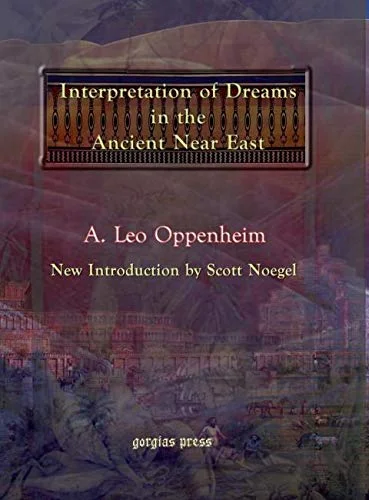
The Interpretation of Dreams in the Ancient Near East
by A. Leo Oppenheim
Our review of A. Leo Oppenheim's The Interpretation of Dreams in the Ancient Near East clarifies its scope, strengths, limits, and the readers who will benefit.
A. Leo Oppenheim was a major figure in twentieth‑century Assyriology, and this study helped set the modern baseline for understanding dreams in Mesopotamia. The book is often cited because it offers both a clear framework for how the ancient Near East treated dreams and a translation of the so‑called Assyrian Dream Book, a technical manual used by specialists to read dreams as omens.
For readers who encounter dreams mainly through Freud, Jung, or modern sleep science, Oppenheim provides a different angle. In Mesopotamia, dreams were signs to be read, not windows into a private subconscious. They sat alongside liver omens, celestial omens, and other divinatory series. This shift in viewpoint can be bracing and refreshing. It shows how deeply cultural context shapes what people think dreams are for.
Set your expectations accordingly. This is a scholarly, philological work. It is about historical practice, not personal growth or therapy. Its influence persists because it anchors discussions of dreams in the ancient Near East in texts, terminology, and a coherent divinatory system.
What this book is, and what it is not
Oppenheim set out to explain how dreams functioned within Mesopotamian divination and to present a translation of a key dream omen compendium. The core achievement is to place dream interpretation within the same technical culture as other omen series, showing its logic, categories, and use by trained experts. The translation brings to life a body of material that would otherwise be inaccessible.
The book does not aim to survey dreams across all ancient Near Eastern cultures in equal depth. Its focus is Mesopotamia, with some references to nearby traditions where relevant. It does not offer therapeutic advice or methods for modern dream work. It does not apply psychoanalytic interpretation to ancient narratives, nor does it test hypotheses with modern sleep research. The translation itself is based on fragmentary tablets, and Oppenheim is careful to mark gaps and uncertainties. Readers should not expect a smooth, continuous “manual” but a painstaking reconstruction of a technical series.
The lens: dreams as omens within a divinatory system
Oppenheim treats dreams as one part of a Mesopotamian science of signs. The basic unit is an omen line with a protasis and an apodosis. In simple terms: “If a man dreams X, then Y will happen.” The interpreter’s task is not introspection. It is classification, recall of canonical cases, and prescription of ritual actions when outcomes look dangerous. This is a public, technical practice tied to ritual specialists and archives, not a private diary.
The worldview is theistic and administrative. Gods send signs. Humans learn to read them using standardized series compiled over generations. Oppenheim distinguishes message dreams, where a god speaks plainly, from omen dreams, where symbolic content requires technical decoding. He also points to the network of parallel omen traditions, such as celestial and terrestrial omens, which organize knowledge through repetition and analogy.
Readers coming from Freud or Jung will notice the contrast. Freud framed dreams as wish‑fulfillment shaped by censorship and displacement. Jung emphasized archetypal motifs and individuation. Oppenheim shows a culture that treated dream images as predictive signals and social facts. The result is a reminder that dream meaning is not a single universal method but a function of a culture’s ideas about causation, fate, and ritual response.
How the book is organized and used
The study opens with an analytical essay that introduces the textual corpus, terminology, and divinatory setting. Oppenheim explains key Akkadian terms, the role of professional interpreters, and links to other omen series. He outlines patterns, such as sequences organized by body parts, actions, social roles, or encounters with deities. This framing essay provides the conceptual map.
The second part presents the translation of the dream omen series. The text is fragmentary, so readers encounter repaired lines, ellipses, and editorial notes. Entries typically read along the lines of “If a man dreams of X, outcome Y.” The arrangement moves by clusters of themes rather than a narrative. Repetitions are common, which reflects the logic of the series rather than an editorial flaw.
As a modern reader, you will likely use the book in two passes. First, read the introduction to grasp the system and its categories. Then consult the translation for examples. It works more like a reference than a story. The apparatus matters. Oppenheim’s notes often clarify idioms, puns, and cultural assumptions that are not obvious in English.
What this book does especially well
Oppenheim’s greatest contribution is to place dream interpretation firmly inside Mesopotamian technical scholarship. That move cuts through modern projections and restores a native logic. The translation itself, even with gaps, gives access to a large and influential compendium that shaped how trained specialists thought about dreams.
Methodologically, the book is careful and concrete. It cross‑references other omen series when a motif overlaps, and it shows how lists build meaning through small variations. This helps readers see why sequences and redundancies are features, not bugs. The treatment of message dreams versus omen dreams is also helpful, since it separates divine instruction scenes in epics and inscriptions from the workaday business of decoding symbols.
The book is valuable for social history. The omen entries preserve glimpses of everyday life, anxieties, and values, from business success to family status and ritual purity. They also show how outcomes were gendered, and how bodily signs, food, and sexuality were encoded within a broader cosmology. For readers outside Assyriology, the work remains one of the clearest windows into an ancient oneirocritical tradition.
Limits, blind spots, and what has aged less well
This is a mid‑twentieth‑century study with the strengths and constraints of its era. The translation draws on fragmentary tablets, so large portions are missing or uncertain. Later editions and additional fragments have refined readings and restored lines in places. Oppenheim’s philology is careful, but the corpus has evolved, and specialists now consult newer handbooks and text editions alongside his work.
The focus is also narrow by design. Egypt, the Levant, and later Greco‑Roman materials receive only minor attention. Readers seeking a cross‑cultural survey will need other books. Oppenheim’s interpretation sometimes downplays personal experience or ritual incubation that falls outside the main omen series. His emphasis on system can understate the variety of dream practices and the human texture behind the texts.
From a modern psychology standpoint, the book offers little engagement with REM sleep, memory consolidation, or cognitive theories of dreaming. That is not a flaw for a historical work, but it limits dialogue with contemporary dream science. The prose assumes comfort with technical terms and with cuneiform scholarship. General readers may find it dense.
Finally, some cultural topics, such as gender and sexuality, reflect both ancient assumptions and mid‑century scholarly framing. Contemporary readers may wish for more explicit discussion of power, status, and embodied experience as they appear in the omen lines.
Where it sits among Freud, Jung, Artemidorus, and modern science
Oppenheim’s book belongs to the study of ancient divination rather than psychology. It presents a culture where dreams were processed like other signs and where expertise meant mastery of canonical lists and ritual responses. In that sense, it stands apart from Freud’s and Jung’s frameworks, which treat dreams as expressions of inner life.
The Greek interpreter Artemidorus, writing in the second century CE, offers a nearer comparison, since he too compiled dream cases and outcomes. Yet Artemidorus comments with a more personal and anecdotal tone, and he addresses broader social audiences. Oppenheim’s Mesopotamian material is earlier, more technical, and more institutional. It is closer to a handbook for specialists than to a conversational guide.
Against modern sleep science, the book reads as a cultural document. Cognitive and neurological accounts ask what the brain is doing in sleep. Oppenheim asks how a society uses dreams in practice. Taken together, these approaches show that dreams can be studied as brain events, personal narratives, and social artifacts. Oppenheim’s work secures the social artifact side with unusual clarity.
Practical guidance for reading and applying this work
Read the analytical introduction first and take notes on key terms and categories. Keep track of how the omen series organizes motifs, since structure carries meaning. Do not rush the translation. The repetitions, formulae, and small shifts often signal how meaning was built.
Pair the book with translations of Mesopotamian narratives that include dreams, such as royal inscriptions or epic passages. This helps you see how technical omen logic differs from literary dream scenes. If possible, consult a glossary of Akkadian terms and a modern survey of Mesopotamian divination to anchor Oppenheim’s references.
Avoid applying the omen outcomes to your own dreams. This book is a historical record, not a method for personal meaning. If you want dialogue with modern theory, read it alongside Freud or Jung and note the different assumptions about agency and symbolism. If you want dialogue with science, pair it with a contemporary introduction to dream research so you can balance cultural logic with findings about sleep and memory.
When teaching, present sample omen lines and ask students to identify the pattern of variation and outcome. This makes the logic visible. When researching, trace a motif across omen series to see how dream signs connect to celestial or terrestrial ones. That cross‑linking is part of the system’s power.
Editorial verdict
Oppenheim’s The Interpretation of Dreams in the Ancient Near East remains a landmark of historical scholarship. It opens a technical tradition to non‑specialists and shows how a culture turned dreams into publicly legible signs. The book is demanding and sometimes dry. Yet its clarity about method and its careful translation make it a touchstone for anyone who wants to understand ancient dream practice on its own terms.
Treat it as a foundation, not a final word. Supplement it with newer text editions and with broader cultural studies. Read it not for personal guidance but for the intellectual satisfaction of seeing a complete alternative to modern psychological models. On that ground, it holds its value.
Pros
- • Authoritative placement of dreams within Mesopotamian divination
- • Translation of a core dream omen series, with careful noting of gaps
- • Clear distinction between message dreams and omen dreams
- • Helpful cross‑references to other omen traditions that reveal system logic
- • Valuable social history embedded in the omen entries
- • Methodological rigor that limits modern projection
- • Useful starting point for comparative studies with Greek or biblical materials
- • Enduring relevance as a primary‑source gateway
Cons
- • Dense, technical prose that can be challenging for non‑specialists
- • Fragmentary tablets lead to many lacunae and reconstructed lines
- • Limited coverage of non‑Mesopotamian traditions within the ancient Near East
- • Minimal dialogue with modern psychology and sleep science
- • Some philological conventions and readings have been updated by later scholarship
- • Understates the role of personal experience and ritual incubation outside the series
- • Assumes familiarity with Akkadian terms and omen literature
- • Not designed for practical personal dream interpretation
Recommended For
- Graduate students and researchers in Assyriology or ancient Near Eastern studies
- Historians of religion studying divination and ritual
- Scholars of dream studies seeking non‑psychological models of interpretation
- Classicists and comparativists working with Artemidorus or biblical dreams
- Librarians and instructors assembling core readings on ancient divination
Not Ideal For
- Readers looking for a modern, personal dreamwork guide
- Beginners who want an accessible overview without technical notes
- Therapists seeking clinically grounded techniques for dream analysis
- General readers who prefer narrative histories over primary texts
- Students without background in ancient history who need a broad survey first
How It Compares
vs. Sigmund Freud, The Interpretation of Dreams
Freud treats dreams as expressions of wish and conflict and develops a method of free association to reach latent content. Oppenheim presents a culture that reads dreams as omens tied to fixed outcomes and ritual responses. Where Freud is inward and therapeutic, Oppenheim is outward and archival. The two books answer different questions about what dreams are for.
vs. Carl Jung, Man and His Symbols
Jung emphasizes archetypes, symbolic amplification, and personal meaning within a mythic framework. Oppenheim documents a technical omen system managed by specialists. Jung encourages individual reflection and symbol play. Oppenheim shows social use, prediction, and ritual mitigation rather than personal growth.
vs. Artemidorus, Oneirocritica
Both works collect dream motifs and outcomes, but Artemidorus writes for a broader public and comments with anecdote and social nuance. Oppenheim’s material is earlier and more institutional, closer to a handbook for diviners. Artemidorus bridges elite and popular practice, while Oppenheim’s source reflects a state‑supported technical archive.
vs. G. William Domhoff, The Scientific Study of Dreams
Domhoff surveys empirical findings about dream content, cognition, and sleep. Oppenheim offers a cultural and textual history with no experimental claims. Use Domhoff to understand how dreams behave across populations today, and Oppenheim to see how an ancient society systematized dream meaning.
vs. Kasia Szpakowska, Behind Closed Eyes: Dreams and Nightmares in Ancient Egypt
Szpakowska examines Egyptian evidence with attention to social practice, ritual, and emotion. Oppenheim focuses on Mesopotamian omen literature and its technical structure. Together they show contrasts in ancient Near Eastern dream cultures, from temple practice and amulets in Egypt to omen series and state archives in Mesopotamia.
Dream interpretation is culturally shaped and not a science. This review is informational and does not provide psychological, medical, or therapeutic advice.