

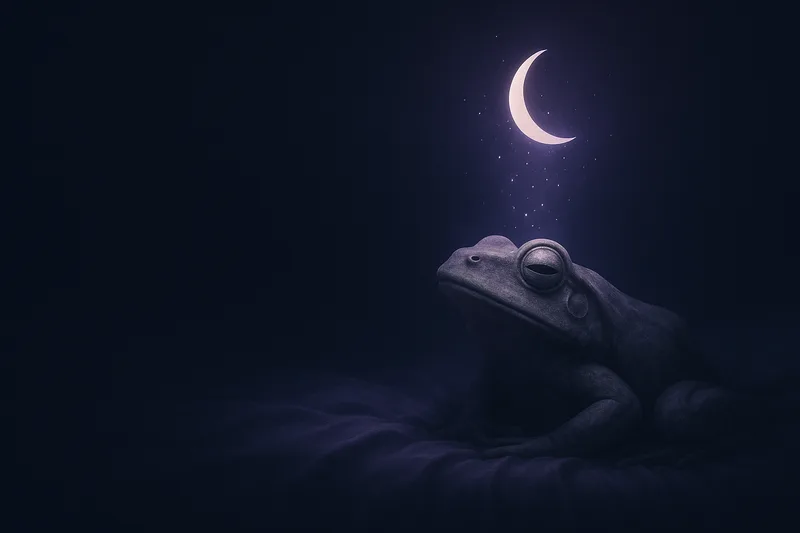
Frog Dreams: Change, Voice, and the Wet Edge Between Worlds
Explore frog dream meaning with psychological, spiritual, and cultural angles. Understand transformation, emotions, and context to interpret your frog dream.
Explore frog dream meaning with psychological, spiritual, and cultural angles. Understand transformation, emotions, and context to interpret your frog dream.
A frog is a small creature with a big presence. It waits in stillness, then moves in a burst. It breathes water and air across a lifetime. That in-between quality makes frog dreams feel charged. They can be cute, unsettling, or oddly wise. You might wake with a sharp memory of rubbery skin or a sudden leap, and wonder why such a simple animal left a mark.
Dreams often pick symbols that can do more than one job. A frog can suggest transformation, since tadpoles change into adults. It can also point to voice and expression, because frogs are heard before they are seen. For some people the frog’s dampness hints at emotion, intimacy, or boundaries. For others, it raises questions about cleanliness, safety, or vulnerability. None of these are fixed meanings. They are doors into your own associations.
This guide treats frog dreams as layered signals rather than fortune-telling. We will look at psychological angles, archetypal patterns, and cultural and religious nuances. You will find practical steps, reflective questions, and a range of scenarios. Hold the dream lightly and test ideas against your life. Your body’s yes or no usually tells you when an interpretation lands.
Dreams About Frog: Quick Interpretation
If you need a quick take, start with the frog’s habitat. Water often mirrors emotion, memory, and the past. Land points to action, boundaries, and the present. A frog moving between the two may be asking how you are crossing from feeling to doing, or from old patterns into new ones. Your response in the dream is a strong clue. Calm curiosity suggests readiness for change. Disgust or fear can signal worry about messiness or loss of control.
A frog that croaks or tries to speak can highlight voice. Are you holding something in, or has your message come out in a blunt croak when you wanted a melody? A frog that multiplies or fills a space can reflect overwhelm. A single frog you protect or carry can point to a new, tentative part of you that needs care.
Most common themes:
- Transformation or growth already underway
- Emotional processing, especially feelings that are hard to name
- Finding your voice, speaking up, or dealing with awkward expression
- Boundaries, hygiene, and comfort with the “mess” of real life
- Fertility, creativity, and renewal
- Luck or opportunity through adaptation, not force
- Hidden concerns surfacing from quiet places
- Social belonging and the sound of your group or community
- The tension between pausing, leaping, and knowing when to do each
If you only remember one thing, remember this: the frog often points to a threshold. Ask what you are nearly ready to leap toward, and what would help you do it with integrity.
How to Read This Dream: A Three-Lens Method
Use three lenses to make sense of a frog dream without forcing a single meaning.
Lens A, emotional tone: How did you feel during and after the dream? Interest and steadiness often suggest integration. Fear, disgust, or shame may signal avoidance or a boundary issue. Relief can show you solved something inside, even if only for a moment.
Lens B, life context: Where are you seeing change, new roles, or pressure to adapt? Consider relationships, work, health, or creative projects. A frog turning up during a big decision can mirror the decision’s messy, amphibious phase.
Lens C, dream mechanics: Notice details. Was the frog silent or making noise? Was it tiny or huge? Was it in your home, a classroom, a river, or a public place? Did it jump away, follow you, or let you hold it? These mechanics often shape the message.
Questions to prompt clarity:
- What exact moment in the dream felt most vivid or strange?
- How close did you get to the frog, and who moved first?
- Did water, mud, or dampness appear, and how did that feel in your body?
- Was your voice clear, stuck, or entirely absent?
- Did others see the frog the same way you did?
- What decision or shift have you been postponing?
- What would happen if you did nothing at all?
- If the frog were a part of you, which part would it be?
- If the frog were a person in your life, who would it resemble?
- What would the frog want from you if it could ask?
Psychological Perspectives
Modern psychology often views dream imagery as a blend of memory residue, emotional processing, and problem-solving. Frogs can carry a surprising amount of emotional weight because they sit at a boundary. They are sensitive to environment, quick to react, and associated with dramatic life change. In this lens a frog might represent a changing identity, a need to regulate emotion, or the tension between stillness and action.
Stress and conflict: If your days feel crowded, a frog that multiplies may mirror that sense of overload. If conflict is simmering, a frog’s sudden leap can echo a startle response. People who are managing social friction sometimes dream of a frog croaking too loudly, as if a private issue has become public.
Avoidance and boundaries: Disgust toward the frog can signal a wish to avoid emotional messiness. It can also point to sensory sensitivity or hygiene concerns. If you feel invaded by others’ needs, a room full of frogs might symbolize intrusions or the difficulty of keeping your space clear.
Identity and change: Tadpole to frog is a clean arc many of us can feel. A frog in a dream can point to the adolescent, the beginner, or the part of you that does not quite belong on land yet. Handling a small frog gently can show respect for your own early-stage growth.
Memory residue: A recent documentary, a child’s toy, or a soundscape of rain can feed the dream. This does not erase meaning. The mind often stitches fresh impressions to ongoing themes.
Attachment and voice: Frogs vocalize to connect, warn, and attract. If your voice felt swallowed during the day, a croaking frog might reflect the body’s attempt to return sound to the system.
Here is a small map to link dream features to possible themes and self-questions.
| Dream feature | Often points to | Try asking yourself |
|---|---|---|
| Frog in clean water | Emotional clarity, readiness to act | What truth am I ready to bring into action? |
| Frog in muddy water | Mixed feelings, uncertainty, old issues stirring | What is murky here, and what would help me clarify it? |
| Many frogs swarming | Overwhelm, boundary strain, social noise | Where can I simplify or say no this week? |
| Frog trying to speak | Voice, expression, timing | What needs saying, and what would be a kind way to say it? |
| Frog in my bed/home | Intimacy, privacy, daily routines | What boundary or habit needs a small adjustment? |
| Holding or helping a frog | Care for tender growth, compassion | What early-stage part of me needs protection? |
| Killing or driving away a frog | Resistance, fear of mess, decisive boundary | What am I refusing, and is that refusal wise or reactive? |
Archetypal and Jungian Lens
This is one perspective among many. From a Jungian angle, a frog can carry archetypal energy linked to transformation, liminality, and the shadow. Liminal means being at the threshold between states. The frog moves between elements. Its eyes sit high, watching both above and below. This makes it a fitting symbol for awareness that stretches across layers of experience.
Archetypes are not props with fixed meanings. They are patterns that organize experience. The frog’s metamorphosis can resonate with the archetype of rebirth. The animal’s slick skin and sudden leaps can echo the trickster, who disrupts routines and asks us to adapt. In fairytales a frog can hold a royal secret. The ugly or awkward aspect hides a latent potential. Dreaming of a frog that is hard to love may invite a conversation with a disowned part of yourself.
Shadow work sits close to frog imagery. Many people feel immediate disgust toward a frog’s texture or environment. That response can be literal. It can also be a hint that something valuable is coated in slime. In some dreams a kiss changes the frog into a partner or ally. The kiss can symbolize a willingness to meet the uncomfortable and discover what it becomes under care.
If a frog guides you toward water, the dream may suggest entering feeling states you usually avoid. If it hops onto land and faces you, it may be time to engage with the practical side of your growth. The key is dialogue. Ask the frog a question inside the dream if you become lucid, or in waking life through writing. You may be surprised by what answers back.
Spiritual and Symbolic Meanings
Spiritually, frogs often signal renewal. The cycle from egg to tadpole to frog mirrors renewal in human life, not as a perfect metaphor but as a living pattern. For some people this points to the soul’s movement through learning phases. For others it is simply a reminder that change is natural and not always neat.
Rituals of change often feature water, cleansing, and voice. A frog’s call near dusk can feel like a bell that ends one part of the day and begins another. In a dream, hearing or holding a frog can be an invitation to pause, breathe, and acknowledge a threshold. Small personal rituals help here. A change in your morning routine, a moment of silence before a big conversation, or washing your hands with intent can anchor the dream’s message.
Some people associate frogs with abundance because they thrive when water and environment are healthy. If your dream includes a lush setting and a comfortable frog, it may reflect a sense of alignment. If the environment is dried up and the frog is struggling, the dream might ask what nourishment is missing. Nourishment could be material, emotional, or spiritual.
In dreams, a frog rarely shouts a prophecy. It tends to sit at the edge and wait for you to come close.
Most of all, the frog can symbolize honest relationship with change. Not forcing it. Not backing away forever. Meeting it with respect.
Cultural and Religious Overview
Frogs appear in many cultures with varied meanings. Local climate, agriculture, and stories shape how people relate to them. In regions where frogs signal rain and crop health, they may be linked with luck and fertility. In places where they are tied to plagues or invasions, they may carry warnings. Traditions do not speak with one voice, and interpretations also shift across time.
This section offers broad themes and respectful examples from several traditions. Use them as context rather than rules. When a culture holds frogs as sacred or as pests, that feeling often arises from lived experience. If a tradition is yours, you may feel a deeper resonance with its meanings. If it is not, approach with care and curiosity. A dream works best when it is connected to your real life and values.
Christian and Biblical Perspectives
In the Bible, frogs appear most prominently in the Exodus story as one of the plagues in Egypt. There, they mark disruption and judgment, filling homes and spaces where they do not belong. Later Christian commentary varies. Some writers read frogs as signs of unclean speech or deceptive voices, based on passages where unclean spirits are compared to frogs. Others see them simply as a symbol of overwhelming consequences when a society refuses to change course.
Dreaming of frogs in a Christian frame might raise questions about order and repentance, but not all frog dreams are warnings. A single frog by water, especially in a peaceful setting, can instead point to renewal and baptismal imagery. Water as cleansing, the move from old life to new life, and the humility of small creatures can all color the dream.
Context shifts the tone. Frogs swarming over a table or bed in a dream might feel like a loss of sacred space. This could nudge the dreamer to clear habits that crowd out prayer or reflection. A frog that speaks or croaks loudly could mirror worries about gossip or unhelpful words. A frog you rescue from a dry place might symbolize mercy and care for creation.
Common angles that some Christians consider:
- The state of the heart before God, especially around speech and integrity
- Renewal themes, including baptism and turning away from what no longer fits
- Stewardship of environment and gentleness toward living things
- Discernment when something that seems small begins to take over
As with any symbol, seek guidance through prayer, scripture reading, or counsel from someone you trust. The meaning that lands with humility and peace is often the most useful.
Islamic Perspectives
Classical Muslim dream interpreters wrote about animals with care, and frogs appear in several collections. Interpretations are not uniform. Some sources connect frogs with piety, because frogs were said to praise God and because their presence can be linked with rain and environmental balance. Others warn that excessive numbers can indicate disturbance.
If you dream of a frog near water performing its natural behavior, this can suggest a person or quality in you that is devoted and patient. A frog leaving water and turning up where it does not belong might indicate being out of place or a situation where one’s nature is not respected. Helping a frog back to water can symbolize helping someone return to their right environment.
As in many Islamic interpretations, scale matters. One frog in the right setting can be a blessing. A vast number in a home can indicate nuisance or social trouble. A frog that croaks endlessly can hint at noise or rumor. A silent frog you carry gently might mirror the restraint of speech and the value of quiet worship.
Context in your life should guide how you weigh these ideas. If the dream leaves you unsettled, personal prayer, charity, or making amends where needed can restore balance. Seek counsel from a knowledgeable person if the dream touches on sensitive life decisions.
Jewish Perspectives
Jewish tradition holds multiple voices about frogs. The Exodus narrative features frogs as a plague that invades private and communal spaces. Later commentaries and midrash explore details playfully and seriously. Some explore how a small creature can become an instrument of change, raising questions about justice and stubbornness.
In a dream setting, a frog that invades a holy or intimate space could echo the sense of boundary violation found in the plague story. This might point to cluttered schedules, too much noise, or habits that fill what should be restful. On the other hand, the persistence of frogs can suggest resilience. A single frog singing after rain can evoke renewal, seasonal rhythms, and gratitude for life’s cycles.
Jewish practice often values debate and layers of meaning. If the dream stirs concern, one response is to examine your gates, the daily openings where you let in influences. Another is to mark transitions with small rituals, such as washing hands upon waking with intention, or pausing for blessings that acknowledge change and provision.
A frog you protect or return to water might invite a compassionate act toward someone who needs the right setting to thrive. Excessive frogs can hint that it is time to reduce inputs and guard speech. As always, interpretation is personal. Seeking a rabbi’s guidance can help when the dream feels spiritually charged.
Hindu Perspectives
Hindu traditions, diverse and regional, often associate frogs with rain, fertility, and seasonal cycles. In some areas folktales and rituals honor frogs during monsoon as a way to align with nature’s rhythms. These practices respect the frog as a sign of ecological balance and abundance.
In a dream, a frog near clear water and green growth might reflect auspicious timing, especially for creative or family matters. A frog that appears in a household shrine or ritual context could signal the need to refresh vows or clean the sacred space. Conversely, a frog out of place may show a misalignment of duties or a habit that disrupts harmony.
Hindu philosophy often engages with transformation through stories and symbols. The metamorphosis from tadpole to frog can mirror spiritual development, the passage from ignorance to clearer seeing. A gentle interaction with a frog can point to ahimsa, non-harm, toward small beings and toward emerging parts of the self.
If the dream feels positive, consider simple offerings to balance elements in your life, such as lighting a lamp or spending time near water with gratitude. If it feels unsettling, examine routines, diet, and how you are stewarding your environment. Local customs and family traditions will color the meaning, so listen to those first.
Buddhist Perspectives
Buddhist approaches to dreams often focus on mind states rather than fixed symbols. A frog can be seen as a temporary appearance shaped by causes and conditions. Its presence invites awareness of change. The body of a frog, soft and exposed, can also remind the dreamer of vulnerability and compassion for all beings.
If the frog is at peace, the dream might point to a mind that can rest at the edge of experience without grasping. If the frog leaps and startles you, it may reflect reactivity. Watching the frog without pushing it away or chasing it can mirror meditation practice: letting phenomena arise and pass.
Ethical reflection can also enter. Saving a small animal in a dream might reinforce a commitment to kindness. Killing or harming can reveal anger or aversion. The point is not guilt, but understanding what triggers your movements. If a crowd of frogs overwhelms a room, consider your inputs. What media, tasks, or conversations are filling your mind?
Small practices help translate the dream. Sit for a few minutes, breathe, and imagine offering safety to the small creature at the threshold. Then ask what threshold in your own life could use that same gentle attention.
Chinese Cultural Perspectives
In Chinese culture, frogs are commonly linked with prosperity, rain, and seasonal luck. Folk imagery includes the three-legged money frog in feng shui, used by some as a charm for wealth. Rural life has long connected frogs with healthy fields after rain. These associations are not the same everywhere, and modern urban life adds new layers.
In a dream, a plump frog near a doorway or a water jar might feel auspicious, pointing to opportunities or the need to circulate resources wisely. A chorus of frogs after rain can suggest the right timing to act. Too many frogs in the house can feel like clutter or gossip crossing thresholds.
If the dream leaves a warm impression, you might tidy your entryway or settle small debts as a way to mirror the flow. If the dream feels off, reduce noise, both literal and social. Intentional placement of meaningful objects, including water features, can remind you to balance elements. Treat these as personal practices rather than magical guarantees.
Native American Perspectives
Native American traditions are diverse, with different nations and communities holding distinct stories about animals. Some communities associate frogs with rain, cleansing, and the voice that calls storms. Others speak of frogs as helpers at transitions between seasons or as trickster-like figures who disrupt habits. These are broad themes rather than universal rules.
If your own community has teachings about frogs, start there. The sound of a frog can mark cycles, the return of certain foods, or the health of wetlands. In a dream, a frog arriving at a doorway might invite preparation for change, both practical and ceremonial. A frog in a dry place can raise concerns about balance and care for the land.
When a dream feels connected to heritage, respectful steps include speaking with elders, engaging in approved practices, or spending time on the land with gratitude. If the dream shows a crowd of frogs, consider how community voices are being heard or drowned out. If the frog is harmed, reflect on what needs healing. Avoid generalizing across nations. Specificity and relationship matter.
African Traditional Perspectives
Across African regions, communities hold varied relationships with frogs. In some areas frogs signal rain, fertility, and the well-being of fields and families. In other contexts they can be treated with caution, especially when linked with illness or environmental imbalance. Oral histories and local ecology often shape these meanings.
In a dream, a healthy frog near water might echo hopes for growth or restoration. A frog inside storage or sleeping spaces can feel like an intrusion that needs action. Songs, proverbs, and seasonal markers influence interpretation. A chorus after the first rains may carry a feeling of relief, while a frog appearing during drought might stir worry and a call for care.
If the dream nudges you toward action, that action can be practical. Tidy the home, support a neighbor, or reduce waste. If it leads to spiritual reflection, align with guidance from your family or community leaders. Because traditions differ, avoid adopting meanings without relationship and context.
Other Historical Notes
In ancient Egypt, frogs were linked to fertility and the annual flood of the Nile that brought life to the fields. The goddess Heqet, often depicted with a frog head, was associated with childbirth and renewal. Seeing frogs after inundation meant the land was breathing again.
Greek and Roman sources include frogs in fables and comedies. They carry the voice of the chorus, sometimes mocking, sometimes wise. The frog’s call in these contexts often highlights public speech and the noise of crowds. For a modern dreamer, this historical echo can color a frog’s croak as social commentary or a reminder to discern signal from noise.
Medieval European bestiaries sometimes portrayed frogs with mixed feelings, on the one hand natural creatures, on the other linked to damp places considered unhealthy. This ambivalence mirrors how many of us feel in dreams. Frogs can be both lively and unsettling, both lucky and too much.
Scenario Library: What Your Frog Was Doing
Use this library to match the feel of your dream with a theme. Focus on the scenario that best fits the strongest image you remember.
Chase and Pursuit
A frog is chasing you
Common interpretation: Being chased by a frog can sound absurd, which is part of its message. You may be running from a small but persistent change. The dream exaggerates the chase to show how avoidance gives the frog power. It also points to discomfort with the wet or messy side of life, including feelings you would rather skip.
Likely triggers:
- Procrastinating on a small task that has grown large in your mind
- Avoiding an awkward conversation
- Sensory aversion to mess, illness, or bodily topics
- Feeling watched or judged
Try this reflection:
- What would happen if you stopped running and turned around?
- What small step could make the situation feel manageable?
- Is your fear about the frog itself or about being seen?
- Where could you ask for help to reduce the pressure?
You are chasing a frog
Common interpretation: Chasing the frog can show eagerness to capture a change before it is ready. Desire outpaces patience. The dream may invite a softer grip. Sometimes it reflects pursuit of a creative idea that keeps slipping away. Chasing near water can hint that you must meet the idea on its own terms, not drag it onto dry land too soon.
Likely triggers:
- Rushing a project
- Impatience with a learning curve
- Pressure to define a relationship
- Anxiety about timing
Try this reflection:
- What would it look like to court the change instead of capture it?
- Where can you allow more time?
- Are you ignoring important conditions, like rest or research?
- Who could help you set realistic milestones?
Threat and Harm
A frog bites or harms you
Common interpretation: Frogs rarely bite in real life, which makes this dream feel symbolic. It can mark a boundary crossed. A small issue has sharp edges. The bite can mirror a stinging comment or an awkward moment that still hurts. It may also reflect health anxieties or concerns about contamination.
Likely triggers:
- A cutting remark
- Conflict at home or work
- Disgust response to something sticky or dirty
- News or media about illness
Try this reflection:
- What recent moment felt like a small hurt with a big sting?
- What boundary needs reinforcement?
- How can you tend the wound without escalating the conflict?
- What calms your nervous system when you feel contaminated?
Killing or escaping a frog
Common interpretation: Driving the frog away or killing it can symbolize a forceful boundary against change or mess. Sometimes this is healthy. Other times it reflects fear. Notice your feeling after the act. Relief suggests you needed the boundary. Shame or unease suggests you silenced something that needed a voice.
Likely triggers:
- Decluttering or cutting ties
- Saying a hard no
- Feeling overwhelmed by obligations
- Pressure to stay the same
Try this reflection:
- What did you protect by removing the frog?
- What might you have lost by ending it so fast?
- Could a softer boundary have worked?
- How will you handle the next wave with less drama?
Helping and Caring
Helping or saving a frog
Common interpretation: Assisting a stranded frog often shows compassion for your own emerging self. You may be caring for a fragile goal, a new identity, or someone in your circle who needs the right environment. The dream encourages patience and steady attention to conditions.
Likely triggers:
- Starting a new habit or recovery
- Caring for a child, pet, or vulnerable person
- Entering a new role at work
- Rebuilding after a setback
Try this reflection:
- What needs gentle conditions to grow?
- Where can you reduce harsh inputs?
- Which small, routine action would make the biggest difference?
- Who can support you while you support this?
Transformation and Renewal
Tadpoles turning into frogs
Common interpretation: Watching metamorphosis highlights a process you cannot rush. You may be tempted to skip awkward in-between stages. The dream suggests that each phase has its own work. It can also signal hope. If you have felt stuck, change is happening at a cellular level.
Likely triggers:
- Long-term project fatigue
- Puberty or identity shifts in the family
- Training, therapy, or spiritual practice
- Seasonal transitions
Try this reflection:
- Which phase are you in, honestly?
- What support would fit this phase, not the next one?
- How will you measure progress without forcing it?
- What would patience look like this week?
Size and Number
One small frog
Common interpretation: A single frog draws attention to one clear issue. It may be about voice, boundary, or a new opportunity. Its smallness suggests it is manageable if treated with respect. Do not ignore it.
Likely triggers:
- A specific decision
- Early-stage romance or idea
- A direct but gentle request from someone
- A new health habit
Try this reflection:
- What is the one thing asking for attention?
- What is the simplest next step?
- What would make it feel safe enough to proceed?
- Who needs to hear from you?
A giant frog
Common interpretation: When the frog looms large, a small issue has grown through neglect or fear. It can signal a part of you that feels oversized due to shame or secrecy. It can also be playful, dramatizing your worry so you notice it.
Likely triggers:
- Avoided conversation
- Duties piled up
- Imposter feelings
- Amplifying anxiety with what-if thinking
Try this reflection:
- What practical action would reduce the size by 10 percent?
- What would a compassionate inner voice say right now?
- Is the scale accurate, or did your mind inflate it?
- Could humor help you approach it?
Many frogs
Common interpretation: A chorus of frogs can feel communal, musical, or chaotic. This often reflects social life. Too many notifications, events, or voices drown your own tone. If the chorus delights you, you may be ready for teamwork.
Likely triggers:
- Group projects
- Family gatherings
- Social media overload
- Neighborhood noise
Try this reflection:
- Which voices help, and which ones blur your focus?
- What limit would protect your attention?
- Where could you invite harmony rather than more noise?
- Do you need silence to hear yourself?
Communication and Voice
A frog croaking, or you lose your voice
Common interpretation: The frog’s croak can mirror messages that come out rough. You may be afraid of sounding silly or too loud. Losing your voice while a frog calls can point to envy or the sense that others are heard and you are not.
Likely triggers:
- Public speaking stress
- Relationship talks
- Being talked over at work
- Judgment from peers
Try this reflection:
- What is your message in one clear sentence?
- Who is a safe first listener?
- How can you practice tone without self-punishment?
- What boundary helps you finish your thought?
Place Matters
Frog in your bed
Common interpretation: Bed is where you rest and connect. A frog there can symbolize intimacy issues, fertility questions, or sleep hygiene. It can also be a call to clean your space or update a routine.
Likely triggers:
- New relationship or sexual concerns
- Pregnancy or contraception questions
- Sleep disruptions
- Clutter around the bed
Try this reflection:
- What would make your bed feel safe and restful?
- What conversation needs to happen with a partner?
- Do you need a screen-free wind-down?
- How do you feel about bodily topics right now?
Frog in the house, at work, or school
Common interpretation: Where the frog shows up points to the arena of change. Home means family patterns. Work points to roles, ambition, and voice in groups. School highlights learning curves and evaluation.
Likely triggers:
- Promotion or role shift
- Moving homes
- Exams or performance reviews
- Family negotiations
Try this reflection:
- What change belongs specifically to this place?
- Who are the allies here?
- What skill would make this leap smoother?
- What boundary keeps things respectful?
Frog in water or a childhood place
Common interpretation: Water plus a childhood setting often signals memory work. Old feelings are ready to be felt and updated. You may be revisiting your earliest sense of belonging or fear.
Likely triggers:
- Family contact
- Old photos or objects
- Therapy milestones
- Returning to your hometown
Try this reflection:
- What did that place mean to you then?
- What do you know now that your younger self did not?
- How can you offer comfort to that younger part?
- What story are you ready to retire?
Someone Else’s Experience
Watching someone else deal with a frog
Common interpretation: Seeing another person handle the frog can mirror your view of their change. You may also be projecting. The dream asks whether you are a helpful witness or a critic from the sidelines. If the other person struggles, the dream could be a nudge to offer support without taking over.
Likely triggers:
- Partner or friend in transition
- Parenting worries
- Supervising at work
- Social comparison
Try this reflection:
- What is actually yours to do here?
- How can you support without controlling?
- What belief about them might be a mirror of you?
- What would respect look like in practice?
Modifiers and Nuance
Certain modifiers can tilt the meaning.
Dream emotions: Fear suggests avoidance or boundary strain. Disgust points to sensory or moral concerns. Calm curiosity often signals readiness. Joy can indicate a clean arc of growth.
Recurring frequency: A repeating frog dream usually means the theme is active right now. The mind is working on it from several angles. Changes in the dream’s tone across nights can mark progress.
Lucid or vivid quality: Lucidity offers a chance to ask the frog a question or change your distance. Vivid color and texture suggest the body is involved. Pay attention to where you feel the dream in your chest, gut, or throat.
Life contexts: After a breakup, frog dreams can mark resetting identity and boundaries. During grief, a quiet frog near water can be a gentle witness. During pregnancy, frogs may be linked with fertility or protective care for a developing life. Always read through your own values and consult health professionals for medical concerns.
Colors and numbers: Green can signal growth. Brown may point to earth, habit, or tiredness. A gold or bright frog often feels auspicious. One frog highlights focus, three can suggest balance or community, and many can suggest abundance or overload depending on mood.
Use the table below to combine factors:
| Modifier | Tends to nudge meaning toward | Helpful next step |
|---|---|---|
| Fear + many frogs | Overwhelm, boundary breach | Reduce inputs for a week, say two clear nos |
| Curiosity + one frog | Focused growth, readiness | Name one change and take a small action |
| Disgust + frog in bed | Hygiene, intimacy limits | Refresh sleep space, clarify consent and comfort |
| Joy + frogs after rain | Renewal, good timing | Start the project while energy is high |
| Recurring + muddy water | Old issues resurfacing | Journal on the earliest memory of this feeling |
| Lucid + talking frog | Direct guidance, voice work | Ask a question in-dream or write a dialogue |
| Grief + silent frog by shore | Witnessing, gentleness | Create a simple remembrance ritual |
Children and Teens
Children often dream more literally. A frog from a cartoon or a pond visit may show up as-is. Texture and surprise can make frogs either delightful or scary. For kids, frogs often represent curiosity, play, and simple fears about slimy things. Nighttime worries can latch onto that image.
Teens may dream of frogs during body changes, social stress, or new crushes. The frog’s awkwardness can mirror their own. A chorus of frogs can reflect peer noise. A frog in a school setting often points to performance anxiety or feeling out of place.
How to talk with a child: Ask for details. Validate sensations. Keep explanations simple. You can say, sometimes our brains make stories from things we saw and feelings we had. Frogs can mean we are learning and growing, and sometimes that feels weird. Let the child lead with their own ideas.
What not to say: Avoid telling a child the dream predicts anything. Do not dismiss it as silly if they feel scared. Do not force them to touch real frogs to face fear unless they want to and it is safe.
Bedtime reassurance: Keep the room calm. Use a night light if helpful. Create a small ritual, like placing a friendly frog drawing by the bed to remind them that change and learning are normal. Limit scary media before sleep.
Checklist for caregivers:
- Ask the child to draw the dream and name the frog’s mood
- Link the dream to a recent event in simple words
- Offer a comforting object at bedtime
- Maintain a steady bedtime routine with a wind-down
- Keep explanations honest, short, and non-scary
- Reduce stimulating media in the evening
Is It a Good or Bad Sign?
People often ask if a frog dream is lucky or unlucky. That framing makes sense when facing uncertainty, but it can mislead. Dreams are conversations, not verdicts. A frog in healthy water may feel positive. A swarm in your kitchen may feel stressful. The point is not whether the universe favors you. It is whether the image helps you act with clarity.
See how common scenarios are often experienced and what life themes they point toward.
| Scenario | Often experienced as | Common life theme |
|---|---|---|
| One calm frog by water | Encouraging | Ready for a thoughtful change |
| Many frogs in the house | Stressful | Boundaries, clutter, social overload |
| Helping a frog return to water | Tender | Protecting growth, compassion |
| Killing a frog | Mixed, sometimes relieved, sometimes guilty | Strong boundary vs fear of change |
| Frog in bed | Uncomfortable | Intimacy, hygiene, sleep habits |
| Frog croaking loudly | Annoying or energizing | Voice, speaking up, public attention |
| Giant frog | Overwhelming | Small issue inflated by delay |
Use the feeling as data. Then choose a grounded next step.
Practical Integration
Turn the dream into constructive action. Start small so the symbol stays helpful.
Journaling prompts:
- Describe the frog’s texture, size, and distance. What body feeling comes up as you write?
- Write a short letter from the frog to you. What does it ask for?
- List three thresholds in your life. Which one is ready for a small leap?
Boundary-setting suggestions:
- Choose one commitment to pause or decline this week
- Clean one small area near water, like the sink, to honor clarity
- Set a quiet hour for voice work, like practice or honest conversation
Conversation prompts:
- Tell a trusted person one sentence about the change you are considering
- Ask for feedback on tone, not just content, if voice is the theme
- Invite a partner to co-create a bedtime routine if the frog was in your room
Next-day plan:
- Take a brief walk near water or greenery
- Do one five-minute task you have avoided
- Say a kind no to something that adds noise without value
Treat the dream as a hypothesis. Pick one small action that would be useful even if the dream meant nothing mystical. If it helps, keep going. If it does not, try a different angle. Let usefulness be your guide.
Seven-Day Exercise
Build traction with a one-week plan.
Day 1: Record the dream in detail. Circle three words that capture the mood. Choose one realistic action aligned with that mood.
Day 2: Voice day. Practice saying a key sentence out loud. Record yourself if helpful. Adjust tone until it feels honest and kind.
Day 3: Water day. Spend 10 minutes near water, even if it is a bath. Set an intention for clarity and ease. Notice your breath.
Day 4: Boundary day. Remove one noisy input. Unsubscribe, mute, or decline something. Observe how your body responds.
Day 5: Care day. Do one small act of protection for a tender project or relationship. Document what conditions helped.
Day 6: Leap day. Take a measured risk related to the change you are considering. Keep it reversible and safe.
Day 7: Reflection day. Review the week. What shifted? What will you keep? Write a two-sentence summary to carry forward.
Reducing Recurring Nightmares
If frog nightmares repeat, aim for safety and practical tweaks.
Sleep basics: Keep a regular schedule, a cool dark room, and reduce caffeine later in the day. Avoid intense media before bed, especially content with jump scares or body horror.
Stress reduction: Gentle exercise, slow breathing, or brief mindfulness can lower arousal. Even five minutes helps. Share worries with someone who listens well.
Imagery rehearsal: Rewrite the dream while awake with a different ending. For example, instead of running, you calmly watch the frog and it shrinks to a manageable size. Rehearse this version for a few minutes daily. Many people find that repeated practice weakens the nightmare.
Grounding techniques: If you wake startled, sit up, place feet on the floor, and name five things you see, four you can touch, three you can hear, two you can smell, and one you can taste. This brings you back to the room.
When to seek help: If nightmares cause significant distress, daytime anxiety, or sleep loss, consider speaking with a healthcare professional or therapist. They can help tailor strategies and check for conditions that might need attention.
Frequently Asked Questions
What does it mean when you dream about a frog?
A frog often points to change already in motion. The image lives between water and land, which maps onto feeling and action. If the frog felt calm, you may be ready to move forward. If it felt intrusive, you may need stronger boundaries or clearer conditions.
Look at your response in the dream. Curiosity suggests growth is welcome. Fear or disgust can signal avoidance or a need to clean up the setting, literal or emotional. Attach the meaning to your life area that matches the dream setting, like home, work, or relationships.
Spiritual meaning of frog dream?
Spiritually, frogs are linked with renewal, voice, and timing. Their calls often rise at dusk, marking transitions. In dreams they can invite you to honor thresholds with simple rituals, like pausing before a big conversation or bringing water-like calm to a busy day.
If the dream felt warm, you might be aligned with the season of your life. If it felt uneasy, focus on cleansing and intention. A small daily practice can anchor the shift without forcing it.
Biblical meaning of frog in dreams?
Biblical imagery includes frogs as a plague in Exodus, associated with disorder and consequences when change is resisted. Some Christian readers also connect frogs with unclean speech or disruptive voices. Not all frog dreams fit that frame.
If your dream showed swarms in sacred or intimate spaces, consider boundaries and repentance in a practical, compassionate sense. If it showed a peaceful frog by water, baptismal themes of renewal may apply. Pray, reflect on scripture, and seek counsel if needed.
Islamic dream meaning frog?
Islamic sources vary. Some regard frogs as devoted creatures that praise God, especially when seen in natural settings tied to rain and balance. A single frog near water can suggest patience and piety. Excessive numbers in a home can point to nuisance or social disturbance.
As always, weigh the dream with your personal context. If unsettled, engage in prayer, charity, or reconciliation. Seek advice from a knowledgeable person if the dream touches important life choices.
Why do I keep dreaming about frogs?
Repetition usually means the theme is active. You may be avoiding a change or standing at a threshold. The dream tries different angles until something lands.
Track variations. Are the frogs calmer over time? Are they moving from your bed to the yard, or from murky water to clear? Those shifts can show progress. Choose one small action that would help regardless of symbolism, like setting a boundary or having a brief honest talk.
Frog dream meaning during pregnancy
Frogs are widely associated with fertility and growth, so pregnancy can draw that image into dreams. A gentle frog may reflect protective care for developing life and the need for clean, supportive conditions.
If the dream shows intrusion or mess in sleep spaces, it may express normal worries about comfort and privacy. Adjust routines, prepare the environment, and discuss preferences with your care team and loved ones. For medical concerns, consult a professional.
Frog dream meaning after a breakup
After a breakup, frog imagery often tracks identity changes. The tadpole-to-frog arc can mirror moving from one life stage to another. A frog you rescue might symbolize your own healing. Many frogs in a shared home can echo the need to make space for yourself again.
Use the dream as a gentle plan. Clear out items that carry old energy, set quiet time for feeling, and make one small leap that belongs to you alone.
Is dreaming of frogs a bad omen?
An omen frame can feel tempting, but frog dreams usually work as feedback, not fate. A peaceful frog can feel encouraging. A swarm might highlight overload. Neither is a fixed prediction.
Treat the dream as a nudge. Ask what practical step would improve your situation whether or not the dream was prophetic. This keeps you empowered and reduces anxiety.
I dreamed of a giant frog. What does that mean?
A giant frog often symbolizes a small issue amplified by delay or fear. When we avoid a conversation or task, the mind can scale it up to get our attention. It can also represent a part of you that feels too big because it has been kept secret.
Bring the scale down by breaking the task into one action. If the giant frog felt friendly, the dream may be using humor to show you that you can handle it.
A frog was in my bed in the dream. Should I worry?
This image often points to intimacy, privacy, or sleep habits. It can also signal a need to refresh the space. You do not need to worry, but you can respond.
Make the bed a clean, calm place. If the dream touches sexual or relationship concerns, consider a respectful conversation. If anxiety persists, think about bedtime routines that lower stimulation.
What if the frog was talking?
A talking frog is a classic symbol of voice and message. The words matter, but so does tone. Was the voice kind, nagging, wise, or satirical? Sometimes the talking frog reflects your own inner voice testing a new register.
Try writing a dialogue with the frog. Ask a question you care about and let the answer come without overthinking. Keep only what feels constructive.
I saw someone else dealing with frogs in my dream. Is that about them or me?
It can be both. Dreams often project our concerns onto others. Watching someone struggle may mirror your own worries about change. If the person is close to you and in transition, the dream can also reflect real empathy or anxiety about them.
Ask what quality the person represents. Then ask what is actually yours to do. Support can be generous without being controlling.
Does the color of the frog matter?
Color adds tone. Green often reads as growth or hope. Brown can point to habit, fatigue, or the earth of daily life. Bright or gold tones may feel auspicious. Black or gray can suggest caution or seriousness.
Let your personal associations lead. If a particular color reminds you of a sports team, a uniform, or a season, that link might be the key.
I am afraid of frogs. Why would I dream about them?
The mind sometimes uses feared images to carry messages that feel important. Your fear could be sensory or cultural. Dreams can help you rehearse contact with the fear in a safe way.
You can desensitize gently. Look at pictures in daylight, name your body sensations, and step away before overwhelm. Over time, the dream may soften.
How do I stop recurring frog nightmares?
Stabilize sleep, reduce evening stimulation, and practice imagery rehearsal. Rewrite the dream with a calmer ending, like placing the frog back in water, and rehearse it daily. This builds a new script.
Address daytime stressors. Set one boundary, clean one small area, and talk to someone you trust. If nightmares continue and affect your life, consult a professional who works with sleep.
Can a frog dream predict pregnancy or fertility?
Some cultures and individuals connect frogs with fertility. Dreams can reflect hopes or anxieties around family. That is different from prediction.
If fertility is on your mind, use the dream as motivation to care for your body, relationships, and environment. For medical questions, rely on healthcare guidance.
What should I do after a strong frog dream?
Write down the key images and how you felt. Identify the life area most related to the setting. Choose one small, useful action that would help even if the dream had no special meaning.
If voice is the theme, practice a sentence you need to say. If boundaries are the theme, say one kind no. If renewal is the theme, clean or refresh a small space.
Is a frog dream connected to stress at work?
Yes, it can be. A frog at work may point to speaking up in meetings, adapting to new roles, or dealing with cluttered processes. Many frogs can reflect notification overload.
Choose one lever you control. Improve a workflow, mute a channel, or practice a concise update. Small changes in systems can lower the dream’s intensity.
What if the frog was in my childhood home?
That setting often brings memory into focus. The dream may be updating an old story about belonging, safety, or voice. The frog suggests movement between past feeling and present action.
Consider a gentle ritual. Hold a childhood photo, speak one kind sentence to your younger self, and note what adult support you can offer now.
Does a frog dream mean I need to be more spontaneous?
Sometimes. Frogs leap after long stillness. The dream may be nudging you to pair patience with action. But spontaneity is not always the answer.
Ask whether a small, planned leap would serve you better. Aim for responsive, not reactive. The best leap lands on solid ground.